

Author: Jamie Hunt
To help you avoid the common mistakes made when specifying and using stainless fasteners, we have put together a short Do's and Don'ts guide.
There are many different grades of stainless steel. The two commonly used grades are 304 and 316, with 316 being more corrosion resistant than 304. The rule of thumb is that if the fastener is in a corrosive environment (e.g. within 5km of the coast), 316 is preferable, particularly if the fastener is to be seen, as 316 is less likely to 'tea-stain' or develop a brown discolouration.
Grade 316 stainless is suitable for marine applications with washing but not permanently submerged, this is where grades such as 2507, 1.4529 and 254SMO are more appropriate.
For more information, see:
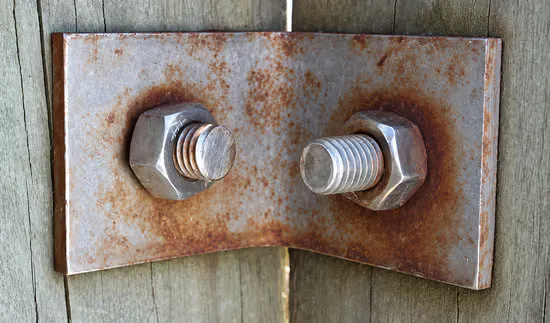
10 metres from the beach. Bracket is 304 and showing signs of rust. 316 nuts/bolts are performing well.
Top stainless fastener engineers recommend that all stainless steel threads should be lubricated before being assembled, to reduce the risk of galling (this is when threads lock up). We have found the most risk of galling is with larger threads (M16 upwards), and also when using nyloc nuts.
We suggest Prolan , Nickel Anti-Seize or Tef-Gel .
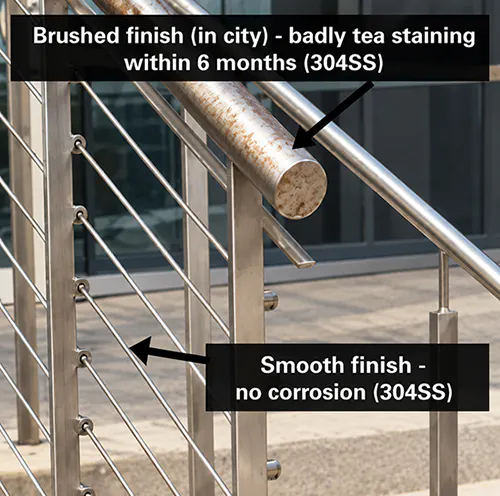
The smoother or more polished the finish, the better the corrosion resistance. Some stainless products have a brushed, satin or 'rougher' finish - e.g. sometimes on hinges, fittings, down pipes. This type of finish can trap minute particles (e.g. salt) which damage the protective chromium oxide layer on the stainless steel, causing 'tea-staining', and therefore giving a rusty appearance. This is made worse if the stainless steel is not exposed to rainwater to wash off the particles.
Electro-polishing or passivating (forms of acid treatment) improves corrosion resistance by thickening the naturally occurring protective chromium oxide layer that forms on stainless steel. All stainless fasteners supplied by Anzor are passivated and can also be electro-polished upon request.
Stainless steel products 'on show' need to be cleaned to remove contaminants (e.g. salt) and therefore maintain the stainless steels appearance. For more information, please see our Cleaning Guidelines →
Stainless steel resists corrosion due to its naturally occurring protective layer ('Chromium Oxide'). When contaminants settle on stainless steel, depending on the grade and the surface finish, these can damage this protective layer, allowing oxygen to react with the iron.
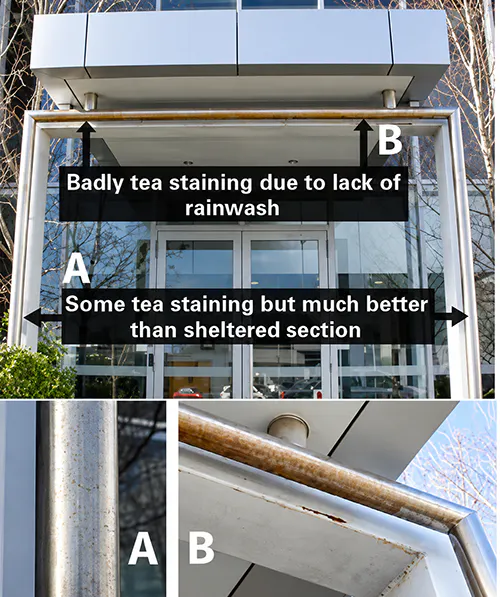
If the stainless steel is exposed to rainwater, then this should wash these contaminants away, restoring the stainless steel's protective layer.
Therefore if stainless steel is going to be sheltered from the rain, and it is in a corrosive environment, then consider options to enhance the corrosion resistance: select a more corrosion resistant grade; a smooth/polished/mirror finish; electro-polishing; and a cleaning schedule .
This is where your tools pass on minute contaminants (e.g. iron fillings). This rust on the surface of the stainless steel and kick-start corrosion. This can also occur when iron fillings from grinding steel are blown onto stainless steel.
How do you reduce the risk of contamination?
This is where two dissimilar metals are in contact, react and cause corrosion. For example, lead or copper flashings on a zinc/aluminium roof. Galvanic corrosion may be a risk for the other metals when they are in contact with stainless steel and the join is wet. Isolating metals with Tef-Gel or nylon/rubber barriers such as a nylon or EPDM washer is a way to keep the metals apart to reduce the risk of this occurring.
Some proprietary grades with high manganese and low nickel have found their way onto the market and are being sold as 304 or 316. Some are even stamped as such. These alloys also have low chromium and are not suitable for harsh conditions - especially coastal environments.
Anzor only deals with high quality, reputable suppliers. We also have a material testing programme using an X-Ray Spectrometer to provide quality assurance.
NB: This DO's and DONT'S guide is provided as a guide only. Anzor does not accept liability for the application of this information. For advice about stainless steel contact the Nickel Institute.

Jamie Hunt is the CEO of Anzor Fasteners Ltd, with 25 years of experience in the procurement and supply of stainless steel fasteners and hardware.
Jamie is a Certified ISSF Stainless Specialist and a member of the New Zealand Stainless Steel Development Association, with extensive industry knowledge across stainless steel fasteners, material selection and corrosion performance.
He also has Olympic yachting experience, bringing a strong focus on performance, technical detail and leadership to his role at Anzor.
Build your deck with Anzor's Stainless Steel Decking Screws
AM Ruspert Concrete Screws: More Fixing Options with Multiple Embedment Depths
Lindapter Girder Clamps: Safe and Secure Connections
Build without delays with Anzor Quick Drill Screws for timber construction.
To receive useful info and product updates add your details below






Request a copy of our Engineering & Marine, or Construction Wall Chart.

Click here to download a PDF of our Engineering Catalogue. This catalogue includes stainless fasteners and fittings, marine hardware and construction brackets.
Click here to download a PDF of our Construction Catalogue. This catalogue includes stainless/galvanized fasteners and fittings, and construction brackets.